
# CNC vs Manual Knife Sharpening: Which Is Right for Your Production Line?
## Quick Answer
CNC knife sharpening machines are ideal for high-volume production environments that demand repeatable precision (±0.02mm tolerance) and minimal operator intervention. Manual knife sharpening machines suit small workshops with lower throughput, diverse blade types, and tighter budgets. Most board processing plants and printing facilities start with manual machines and upgrade to CNC when daily sharpening volume exceeds 20–30 blades.
—
## The Real Cost of Choosing Wrong
Every workshop manager I’ve talked to has made the same mistake: buying a machine that’s either too basic or too advanced for their actual needs.
A small signage shop in São Paulo bought a fully automatic CNC grinder because the sales rep said it was “the future.” They spent $18,000 on a machine that sat idle 70% of the time because they only sharpened 5 blades per day. Meanwhile, their competitor down the road was doing the same work with a $4,500 manual machine and reinvesting the savings into marketing.
On the flip side, a furniture manufacturer in Ohio kept using a manual sharpener even after their volume hit 40 blades per day. Their operator was spending 3 hours daily just on sharpening — time that could have gone to actual production. The real cost wasn’t the machine; it was the lost productivity.
**The right choice depends on three factors: daily blade volume, tolerance requirements, and operator skill availability.**
—
## CNC Knife Sharpening: When Automation Pays Off
### What CNC Actually Gives You
CNC (Computer Numerical Control) knife sharpening machines automate the entire grinding cycle: blade detection, angle setting, grinding pressure, and cycle counting. The operator loads the blade, presses start, and walks away.
Key advantages:
– **Repeatability**: Every blade gets the exact same grinding profile. Program it once, run it 10,000 times. No variation between shifts or operators.
– **Speed**: A CNC machine can sharpen a standard planer knife in 90–120 seconds, compared to 5–8 minutes on a manual machine. That’s 3–4x faster.
– **Less skilled labor needed**: You don’t need a master grinder operator. Load the blade, press the button, unload the sharp blade. Training takes hours, not months.
– **Data tracking**: Modern CNC machines log blade cycles, grinding time, and wheel wear — useful for predictive maintenance and cost-per-sharpening calculations.
### Where CNC Shines
| Application | Why CNC Wins |
|—|—|
| Board processing plants | High volume of identical planer knives, 24/7 operation |
| Printing facilities | Precise edge geometry for consistent ink transfer |
| Paper converting | Tight tolerance requirements (±0.02mm) |
| Large woodworking shops | Multiple shifts, need consistent results across operators |
### The Downsides
CNC machines aren’t perfect for every situation:
– **Higher upfront cost**: $8,000–$25,000+ depending on features and size
– **Less flexible for odd blades**: CNC excels at standardized blade geometries. If you’re constantly switching between unusual blade types, the programming overhead can negate the speed advantage.
– **Maintenance complexity**: CNC systems have more components (motors, controllers, sensors) that can fail. You’ll need someone who can troubleshoot electronics, not just mechanics.
– **Overkill for low volume**: If you’re sharpening fewer than 10 blades per day, the ROI on CNC is hard to justify.
—
## Manual Knife Sharpening: The Flexible Workhorse
### What Manual Actually Means
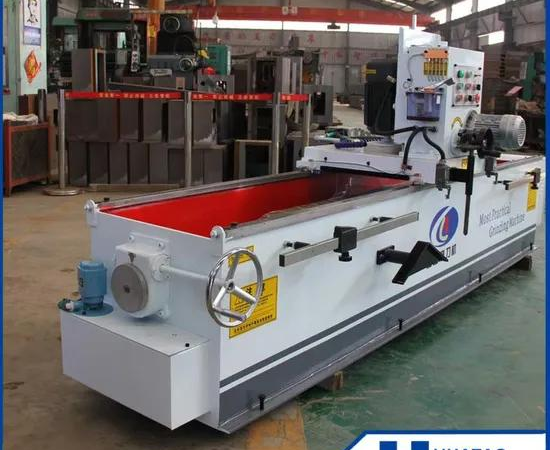
“Manual” doesn’t mean “low quality.” A modern manual knife sharpening machine still uses precision-ground guides, adjustable angle settings, and electromagnetic chucks for blade clamping. The difference is that the operator controls the grinding pressure, feed rate, and determines when the edge is sharp enough.
Key advantages:
– **Lower cost**: Quality manual machines start at $2,000–$6,000
– **Maximum flexibility**: Switch between blade types in seconds — planer knives, chipper knives, shear blades, router bits, even kitchen knives
– **Simpler maintenance**: Fewer moving parts means fewer things to break. Most maintenance is mechanical (belt tension, wheel dressing, chuck cleaning).
– **Better for learning**: Operators develop an intuitive feel for blade sharpness and edge quality — valuable skill in any workshop.
### Where Manual Shines
| Application | Why Manual Wins |
|—|—|
| Small workshops | Low volume, diverse blade types, tight budget |
| Custom fabrication | Non-standard blade geometries that can’t be programmed |
| Multi-purpose shops | Sharpening everything from planer knives to drill bits |
| Developing markets | Lower upfront cost, easier to maintain locally |
### The Downsides
– **Slower throughput**: 5–8 minutes per blade vs 90–120 seconds on CNC
– **Operator dependent**: Results vary between operators and even between shifts. Two operators can produce noticeably different edge quality on the same machine.
– **Higher labor cost per blade**: More operator time = higher cost per sharpening cycle
– **Fatigue factor**: After hours of manual grinding, operator concentration drops, and edge quality suffers.
—
## The Decision Framework: Three Questions
Before you spend money on any knife sharpening machine, answer these three questions honestly:
### 1. How many blades do you sharpen per day?
– **Under 10/day**: Manual machine. The CNC premium won’t pay itself back.
– **10–30/day**: Evaluate your tolerance requirements and labor costs. This is the gray zone where either could work.
– **Over 30/day**: CNC machine. The throughput advantage alone justifies the investment.
### 2. What tolerance do you need?
– **±0.05mm or looser**: Manual is fine. A skilled operator can consistently hold ±0.05mm on a quality machine.
– **±0.02mm or tighter**: CNC. At this tolerance, human consistency becomes the limiting factor on manual machines.
– **Not sure what tolerance you need**: Check your blade manufacturer’s specifications. Most planer knife manufacturers specify ±0.03mm to ±0.05mm.
### 3. Do you have (or can you hire) skilled operators?
– **Yes, or willing to train**: Manual works well. Your investment is in people, not programming.
– **No, and hard to find locally**: CNC reduces your dependency on skilled labor. The machine holds the expertise.
– **High turnover environment**: CNC is more resilient to operator changes. Standardized processes don’t require years of experience.
—
## What About Electromagnetic Chuck Systems?
Both CNC and manual machines can use electromagnetic chucks for blade clamping. This is a separate decision from CNC vs manual.
Electromagnetic chucks provide:
– **Hands-free clamping**: No mechanical clamps to adjust for each blade
– **Even pressure distribution**: Reduces blade distortion during grinding
– **Faster blade changes**: Especially important if you’re processing many different blade types
Most mid-range and above machines (both CNC and manual) come with electromagnetic chucks as standard. If you’re comparing two machines and one has it while the other doesn’t, that’s a significant advantage for the one with the chuck — it directly impacts your cycle time and edge quality.
—
## The Hybrid Approach: Start Manual, Plan for CNC
Here’s what I recommend to most workshop managers who are unsure:
1. **Start with a quality manual machine** (electromagnetic chuck, adjustable angle, variable speed if possible). Budget: $3,000–$6,000.
2. **Track your data**: Record daily blade count, average sharpening time, and edge quality issues for 3–6 months.
3. **Identify the bottleneck**: If sharpening time becomes the constraint on production, start evaluating CNC options.
4. **Keep the manual as backup**: Even after upgrading to CNC, the manual machine serves as backup and handles odd jobs that don’t warrant CNC programming time.
This approach minimizes your upfront risk while keeping the upgrade path open.
—
## Real-World Cost Comparison
Let’s compare the actual operating costs over 3 years for a typical board processing plant sharpening 25 planer knives per day (6,500 blades/year):
| Cost Factor | Manual Machine ($4,500) | CNC Machine ($15,000) |
|—|—|—|
| Machine cost | $4,500 | $15,000 |
| Operator time (3 years) | $54,000* | $18,000** |
| Grinding wheels (3 years) | $3,600 | $4,200 |
| Maintenance | $1,500 | $3,000 |
| **Total 3-year cost** | **$63,600** | **$40,200** |
*Based on 6 min/blade × 6,500 blades/year × 3 years × $0.25/min operator cost
**Based on 2 min/blade × 6,500 blades/year × 3 years × $0.25/min operator cost
At 25 blades per day, the CNC machine pays for itself in about 18 months through labor savings alone. Below 10 blades per day, the manual machine wins on total cost.
—
## Final Recommendation
There’s no universally “better” option between CNC and manual knife sharpening. The right choice depends entirely on your specific situation:
– **Choose CNC if**: High daily volume (>20 blades), tight tolerances needed, limited skilled operators, multi-shift operation, standardized blade types.
– **Choose Manual if**: Low-to-moderate volume (<15 blades), diverse blade types, limited budget, skilled operators available, custom or non-standard geometries.
- **Choose Hybrid if**: You're growing but not sure yet. Start manual, track data, upgrade when the numbers justify it.
Whatever you choose, buy from a manufacturer that provides technical support, spare parts availability, and operator training. The machine is only as good as the support behind it.
---
*Looking for a knife sharpening machine that fits your production needs? [Contact us](https://loghawktech.com/contact-us/) for a free consultation — we'll help you determine the right machine based on your blade volume, tolerance requirements, and budget.*
## Common Mistakes When Switching from Manual to CNC
If you've been using a manual machine for years and are considering upgrading to CNC, watch out for these common pitfalls:
**Expecting zero operator involvement.** CNC machines still need attention. Blades need to be loaded correctly, chucks need to be clean, and grinding wheels need periodic dressing. The difference is that the operator spends more time on preparation and less time on the actual grinding.
**Ignoring the learning curve.** Programming a CNC sharpener isn't difficult, but it does require understanding grinding angles, feed rates, and wheel speeds. Budget 2–4 weeks for an operator to become proficient. During this period, quality may temporarily dip below what your experienced manual operator produces.
**Forgetting about tooling.** CNC machines often use different grinding wheel specifications than manual machines. Make sure your wheel supplier can provide the right specifications for your CNC model, and keep a few spares on hand.
**Not updating your workflow.** Simply replacing a manual machine with a CNC one without adjusting your workflow wastes the CNC's advantages. Reorganize your sharpening area for batch processing: load all blades for a job, run the CNC cycle for all of them, then unload. This batch approach maximizes the CNC's throughput advantage.
## Maintenance Differences Between CNC and Manual
Maintenance requirements differ significantly between the two types:
**Manual machine maintenance (weekly):**
- Clean electromagnetic chuck surface
- Check and adjust belt tension
- Dress grinding wheel (5 minutes)
- Inspect coolant levels and nozzles
- Check angle scale calibration
**CNC machine maintenance (weekly):**
- All of the above, plus:
- Clean and inspect ball screws and linear guides
- Check servo motor connections
- Verify controller firmware version
- Back up machine parameters
- Inspect limit switches and sensors
**CNC machine maintenance (quarterly):**
- Full calibration check by qualified technician
- Replace worn ball screw lubricant
- Inspect electrical connections for corrosion
- Update controller software if available
The additional maintenance on CNC machines typically adds $50–$100 per month in parts and labor costs. Factor this into your total cost comparison.
## How to Evaluate Specific Machine Models
Once you've decided between CNC and manual, evaluating specific models comes down to these criteria:
1. **Grinding length capacity**: Make sure the machine handles your longest blade with some margin. A machine rated for 1300mm blades gives you flexibility for future needs even if your current longest blade is 1000mm.
2. **Grinding angle range**: Most industrial knives require angles between 18° and 45° per side. Ensure the machine covers your full range without special accessories.
3. **Electromagnetic chuck strength**: Measured in Newtons. Higher clamping force means less blade vibration during grinding, which directly affects edge quality. Look for at least 5,000N for planer knives.
4. **Grinding wheel speed and feed rate**: Faster isn't always better. Variable speed control lets you optimize for different blade materials (HSS, carbide-tipped, standard steel).
5. **After-sales support**: Can you get spare parts within a week? Is there a technician who can visit your facility? What's the warranty period? These matter more than a $500 price difference.
Request quotes from at least three manufacturers for your chosen machine type. Ask for references from customers in your industry — a good manufacturer will happily connect you with existing customers.
---
## Summary: Your Next Steps
1. **Audit your current sharpening operation**: Count daily blade volume, measure current sharpening time per blade, and note any quality consistency issues.
2. **Calculate your current cost per blade**: Include operator time, wheel consumption, and machine depreciation.
3. **Get quotes for both CNC and manual options**: Based on your volume analysis, request detailed quotes including shipping, installation, and training.
4. **Ask for references**: Talk to existing customers with similar volume to yours. Ask about uptime, support quality, and total operating costs.
5. **Plan for the transition**: Whether you choose CNC or manual, plan for a 2–4 week transition period where quality may fluctuate as operators adapt.
The knife sharpening machine is the backbone of any blade-dependent production line. Choosing the right type — and the right specific model — directly impacts your product quality, operating costs, and production capacity. Take the time to make the right choice.
---
*Need help choosing the right knife sharpening machine for your production line? LogHawk Tech manufactures CNC precision sharpening machines, electromagnetic cutter grinders, and economy manual sharpeners. [Request a quote](https://loghawktech.com/contact-us/) and our team will recommend the right machine based on your specific requirements.*